2026-11-01
Sample Paths From Any Model
One gripe I have with the current era of time series foundation models and forecast research generally is the focus on quantile forecasts. Even more so the promotion of quantiles as the be-all and end-all of probabilistic forecasting. Even though quantiles of marginal distributions do not answer questions such as…
- “What is the probability that half of the product’s inventory will be consumed over the next 12 days?”
- “What is the probability that electricity prices will be higher than 200€/MWh for a period of six hours in the next 24 hours?”
…which concern aggregations across arbitrary spans in the forecast horizon. You need sample paths from the joint forecast distribution to answer these questions.
The research community started out so well back in 2016 and 2017. But then it turned around to follow a different path. It’s easier to build models that forecast quantiles only, so this is where early innovation on foundation models happens. Later on, as the low-hanging fruits are picked, perhaps some research will take care of native sample path forecasts.
With their ability to incentivize researchers, leaderboards are part of the problem. Current leaderboards (GIFT-eval, fev, TIME) focus their evaluation on marginal forecasts. Then again, I wouldn’t want to define a general leaderboard evaluating sample paths. Too many options. Perhaps we need more specialized leaderboards. Anyway.
What makes the absence of sample paths doubly frustrating is that the latest generation of time series foundation models is impressive and should be used as a baseline if nothing else.
A way around this frustration is the following: Take a foundation model’s quantile forecasts and transform them into sample paths post hoc. While the autocorrelation of the resulting sample paths won’t have been learned by the foundation model, this approach could trump approaches that draw sample paths natively due to the quality of the underlying marginal quantiles.
In Efficiently Generating Correlated Sample Paths from Multi-step Time Series Foundation Models (Baron et al., 2025), the authors take that approach. Given a time series and its lag one auto-correlation, they fit a simple copula. They then sample quantile level paths from the copula. Next, they evaluate the marginal forecast distribution at those quantile levels.1 This transfers auto-correlation structure from the copula via the sampled quantile levels into the quantiles. In effect, the resulting values resemble sample paths from a joint forecast distribution.
In Shuffler, I implemented the method described in Baron et al. (2025) to try it for myself. Refer to its README or a detailed tutorial notebook for a worked example, using Chronos-2 to forecast electricity prices and Shuffler to draw sample paths building on Chronos’ quantile forecasts. For brevity I’m not going to rehash the code here. But take a look at the following visualizations that contrast naive samples from Chronos’ marginal forecast distributions with post hoc sample paths via Shuffler on top of Chronos’ quantiles.
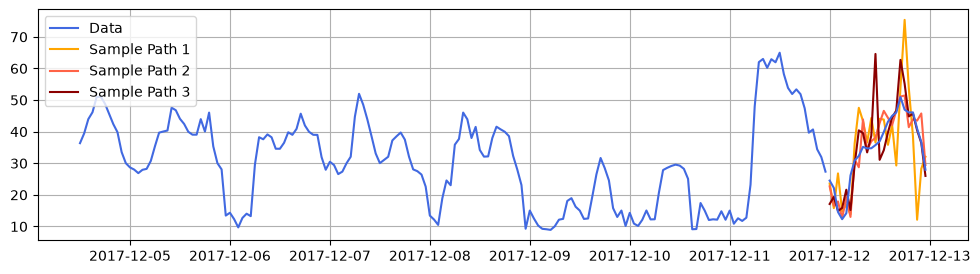
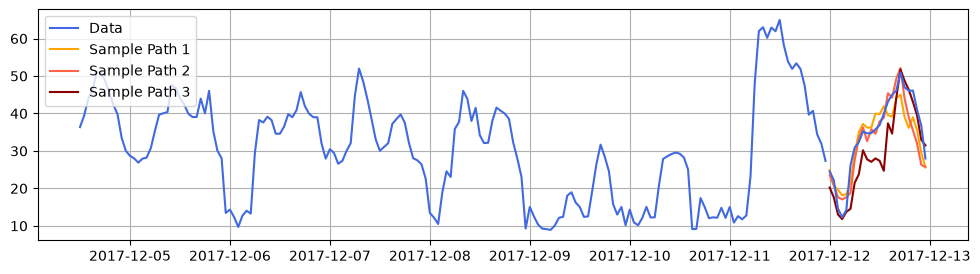
The difference between the two sets of sample paths is striking. The upper image highlights the limitations of marginal distributions: If you draw samples from them naively, each time step in the forecast horizon is independent from the next. This leads to the fluctuating structure in the resulting paths, which is unrealistic when (visually) compared with past data.
In contrast, the bottom image shows what look like realistic future paths of the time series. They are smooth to the extent that the time series changes smoothly.
-
Since only a limited set of quantiles of the marginal distributions are forecasted, you’ll have to approximate the arbitrary quantiles that the copula requests by inter- and extrapolating the known quantiles. The approach taken by Baron et al. (2025) and implemented in Shuffler is described in Learning Quantile Functions without Quantile Crossing for Distribution-free Time Series Forecasting (Park et al., 2021). ↩︎